

The Ancient Ohio Trail
The AOT promotes exploring the distinguished Native American heritage in the Midwest, highlighting historic local settings while suggesting tours and road trips among Ohio's historic towns and scenic roads, and cultural, artistic, and tourist amenities. Virtual Grounds designed and launched the web portal, mobile companion, and 2D map tour. During our long partnership with the AOT leadership, VGI brought an innovative approach to virtual map tours for heritage sites, including AR components for four earthworks sites.
Services: Web portal design and development, mobile-optimized companion site, 2D interactive map tour, Augmented Reality (AR) artifact visualization, and AR on-site walking tours.
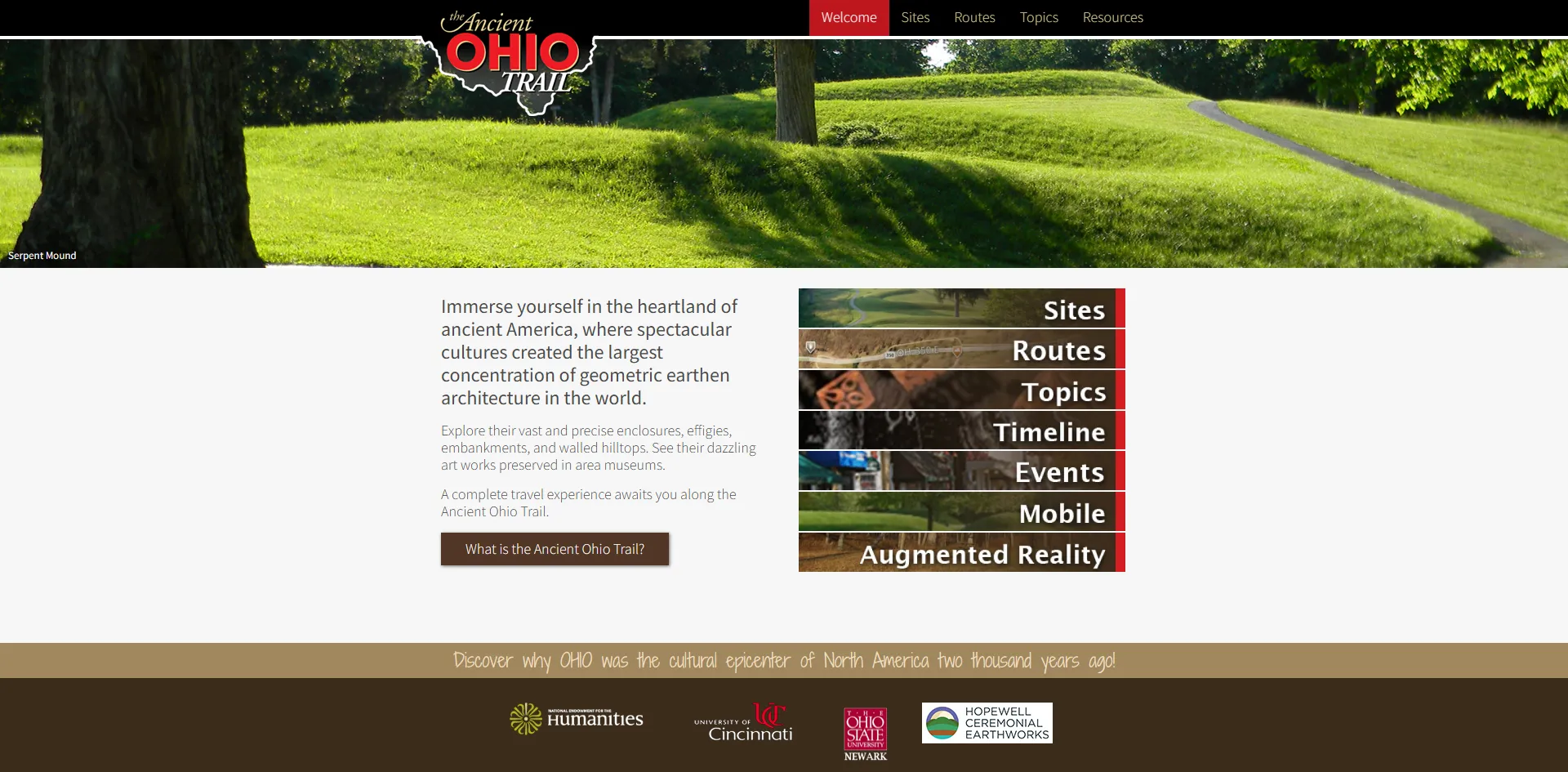
Explore the Ancient Ohio Trail
A comprehensive portal for visitors to immerse themselves in the heartland of ancient America, where spectacular cultures created the largest concentration of geometric earthen architecture in the world. The website includes resources for planning a complete travel experience.
Transmedia Approach
The web portal includes multimedia resources such as video clips and audio for desktop users, and a mobile website companion optimized for smartphone visualization for information on the go.
Forefront of Emerging Tech
Plans for developing the AOT project included emerging technology components from the start. VGI designed and developed AR tours for four earthworks sites featured in the Ancient Ohio Trail. AR was also used to visualize virtual models of selected Hopewell artifacts.
Resources to help visitors discover the distinguished Native American heritage in the Midwest and gain rewarding insights about their culture.


Embracing Augmented Reality
The Ancient Ohio Trail is a comprehensive project about four of Ohio's two-thousand-year-old Hopewell-era earthworks, whose monumental forms and scale are sometimes invisible due to degradation or undergrowth. Augmented reality was introduced early in its inception to support interpretation and visualization of the sites, and bring public access to significant artifacts. Both projects developed for the AOT were pioneers in employing AR for cultural projects, at a time when few understood the technology.
Historical Artifacts in AR
At the launch of the project in 2012, VGI designed and developed an application for the visualization of 3D models of selected archaeological artifacts from the Ancient Ohio Trail project using AR technology. A set of 10 artifacts were triggered by scanning markers from a PDF available for download from the AOT website.
AR Channels for On-Site Tours
VGI designed and developed AR tours for four earthworks sites featured in the Ancient Ohio Trail project, implemented in 2013. The tours were launched by scanning a QR code with a smartphone and showed several points of interest around the visitor in real time. The floating points of interest helped guide the walking tour and also provided extensive written information about the stops.
World-Class Heritage Sites
The Ancient Ohio Trail is a collaboration of all the major owners, managers, and interpreters of the earthworks, and received funding from the competitive National Endowment for the Humanities.
Built nearly 2,000 years ago by a remarkably sophisticated culture, now known as “Hopewell,” eight of these ancient, sacred sites were inscribed on the UNESCO World Heritage List in 2023 as the Hopewell Ceremonial Earthworks.